
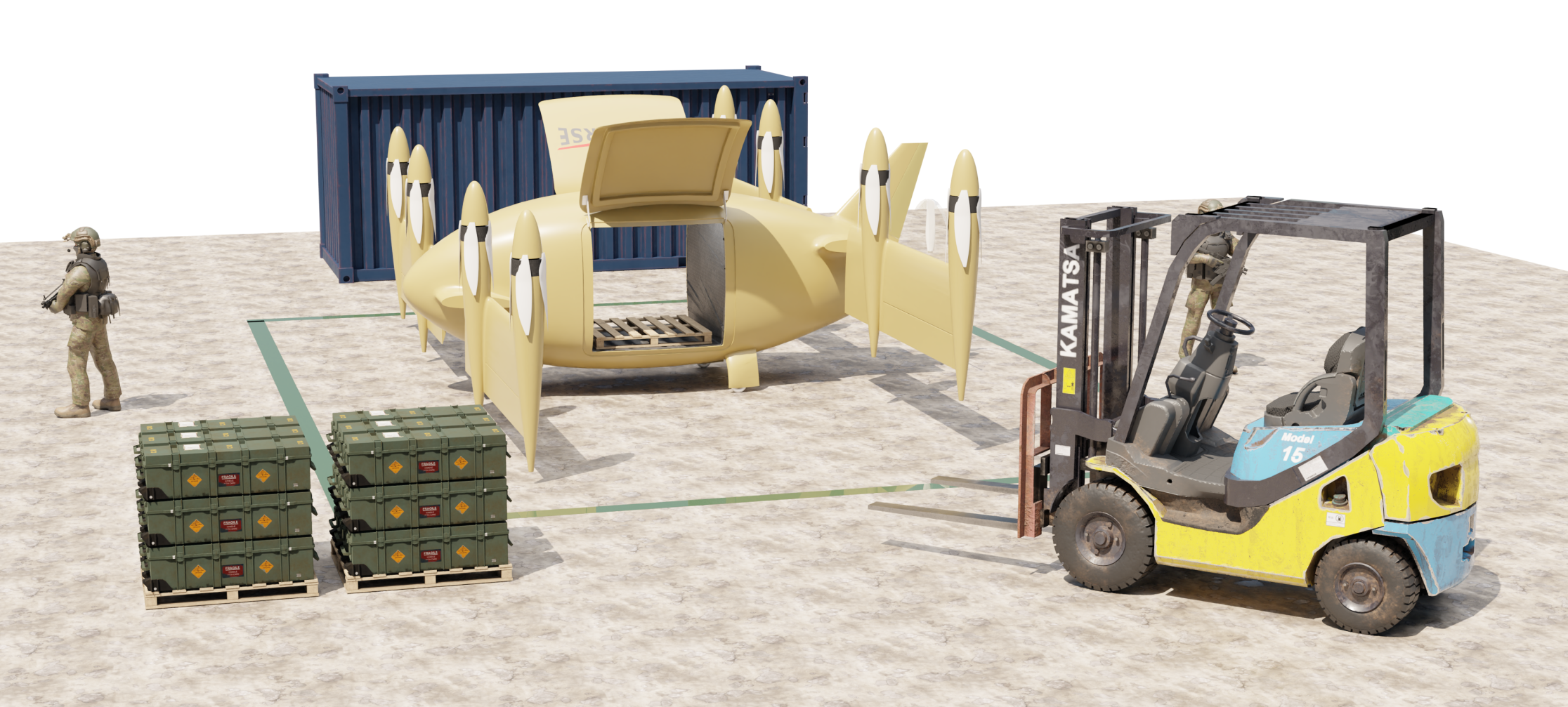
The US Army is fielding autonomous cargo drones to reduce dependence on ground resupply convoys, which remain vulnerable to surveillance, long-range fires, and loitering munitions. The Army evaluated the TRV-150 — a 36-minute eVTOL cargo drone already fielded by the Marine Corps — at Fort Stewart in February 2026. It awarded a production contract for the Joint Autonomous Aerial Resupply System (JTAARS) in May 2026.
Why is the Army moving resupply off the roads?
Ground convoys are a persistent vulnerability: they’re visible to surveillance, exposed to long-range fires, and increasingly at risk from cheap loitering munitions that can find and strike a moving vehicle column. Autonomous cargo aircraft can move smaller loads more discreetly, on flexible routes, without putting soldiers in a vehicle on a predictable road for the length of the resupply run.
What is the TRV-150?
The TRV-150 is a heavy-lift, autonomous eVTOL cargo drone already fielded by the US Marine Corps. The Army evaluated it at Fort Stewart, Georgia on February 12, 2026 for potential broader adoption. It’s built for autonomous resupply of ammunition, food, and medical gear, a 36-minute flight window aimed at short-hop logistics runs rather than long-range transport.
What is JTAARS?
The Joint Autonomous Aerial Resupply System is an autonomous cargo drone program. The Army awarded a production contract for it on May 4, 2026, to SURVICE Engineering. It’s designed specifically to deliver supplies to dispersed ground forces — units spread out rather than concentrated at a single forward base, which is itself a deliberate tactic to reduce vulnerability to concentrated strikes.
Where is this heading next?
DARPA is working on a paired architecture linking small drones with autonomous shipping-container-style hubs. These hubs function as deployable hangars, energy modules, launch-and-recovery stations, and communications relays, infrastructure meant to support distributed drone logistics without needing a fixed base nearby. The global military drone sector is projected to surpass $25 billion in 2026, with the broader defense drone industry expected to exceed $55 billion by 2032. Autonomous long-range drones aren’t limited to resupply missions, either. Ukraine’s Liutyi strike drone uses similar satellite-aided autonomous navigation for one-way attack missions instead.
Sources: Interesting Engineering, Govly on the JTAARS contract.