
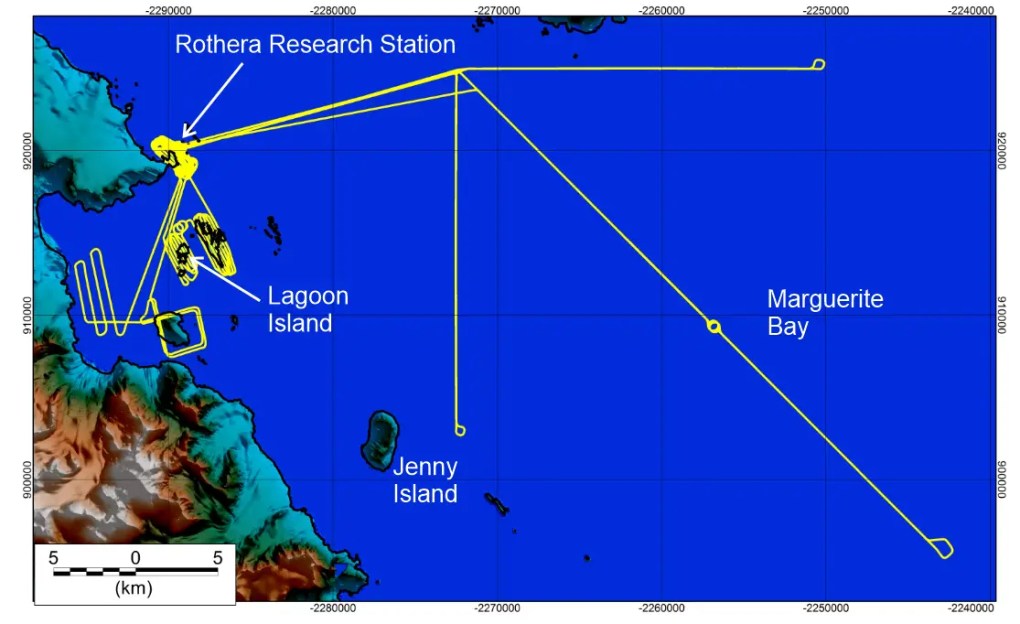
British Antarctic Survey operates a DJI Dock at Signy Research Station, flying pre-programmed missions to survey moss banks, seals, and seabird colonies, controlled remotely from Cambridge, UK, without anyone on-site needing to launch it. Separately, the 10-meter Windracers ULTRA carries 50-60kg of payload for up to 1,000km autonomously. It’s being deployed over Greenland’s Petermann Glacier starting June 2026 to study how melting ice affects ocean currents.
How does a drone survey Antarctica without anyone flying it locally?
The DJI Dock at Signy Research Station is a drone-in-a-box system: the aircraft lives in a weatherproof dock, launches on pre-programmed missions, and can be operated remotely from Cambridge, UK. Researchers thousands of miles away can gather imagery of moss banks, seals, and seabird colonies without deploying staff to physically pilot the drone on-site for every flight.
What is the Windracers ULTRA, and what’s it doing over Greenland?
The Windracers ULTRA is a large autonomous fixed-wing aircraft, 10 meters wingtip to wingtip, capable of carrying 50-60kg of scientific payload and flying autonomously for up to 1,000km beyond the operator’s horizon. As part of the international GIANT programme led by British Antarctic Survey, it’s being deployed starting June 2026 for long-range missions over Greenland’s Petermann Glacier, studying how the region’s melting ice is affecting broader ocean current patterns.
Why does long-range autonomy matter for this kind of research?
Polar and glacier research covers enormous, often inaccessible terrain where crewed aircraft flights are expensive, logistically difficult, and limited by pilot endurance and weather windows. An aircraft that can fly 1,000km autonomously dramatically increases the geographic area and total flight time researchers can cover, without the cost and risk of repeated crewed missions into remote, often hazardous environments.
What’s the broader pattern here?
Both projects point toward the same shift: polar science moving from expedition-based, crewed data collection toward remotely operated and fully autonomous systems. These systems can operate continuously and be controlled from labs thousands of miles from the actual research site, a meaningful expansion in how much ground (and ice) researchers can actually cover.
Sources: Heliguy, British Antarctic Survey.