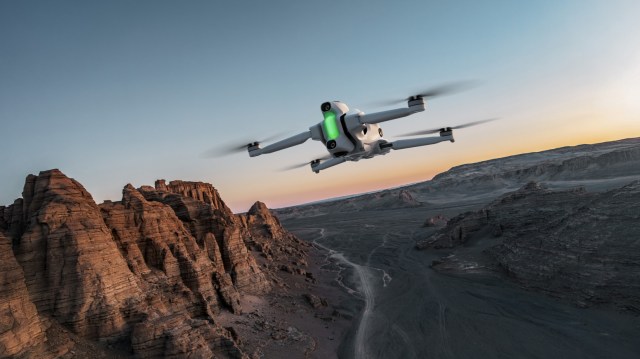
The Antigravity A1, from Insta360’s Antigravity brand, is the first drone to shoot true 8K 360-degree video. It uses a dual-lens 1/1.28-inch sensor system at 8K/30fps, or 5.2K/60fps, or 4K/100fps, in a foldable 249g airframe. It launched December 4, 2025, starting at $1,599, and pairs with Vision Goggles that mirror the pilot’s head movements in real time.
What makes the A1 different from DJI’s Avata 360?
Both are cinewhoop-style 360-degree FPV drones. The A1 pushes resolution further, with native 8K/30fps versus the Avata 360’s 8K/60fps at lower effective detail in some modes, depending on how each brand’s dual-lens stitching is measured. The more distinctive difference is the headset-first design. The A1’s Vision Goggles use dual 1-inch Micro-OLED displays at 2560×2560 resolution and mirror the pilot’s head movements in real time, built around an immersive-flying experience rather than a conventional stick-and-screen setup.
What are the full specs?
- Dual-lens 1/1.28″ sensor system, 8K/30fps, 5.2K/60fps, or 4K/100fps recording
- 249g weight (under registration threshold with standard battery), foldable
- Vision Goggles: dual 1-inch Micro-OLED displays, 2560×2560 resolution, head-tracking mirrored flight control
What does it cost?
Three bundles: the Standard Bundle at $1,599, the Explorer Bundle at $1,899, and the Infinity Bundle at $1,999. It went on sale December 4, 2025 — nearly two months earlier than its originally planned January 2026 launch.
Who is this actually for?
Like DJI’s Avata 360, this is built for immersive first-person and 360-degree content creation rather than traditional aerial photography. Think action sports, run-and-gun shooting, and footage where reframing the angle after the fact matters more than a single fixed composition. See our DJI Avata 360 database entry for a direct spec comparison between the two.
What are its real-world limitations?
Flight time runs shorter than the headline number suggests. The standard battery is rated for 24 minutes, but one reviewer measured closer to 19 minutes in real-world flying. The High-Capacity battery stretches that to 39 minutes and extends range from 13km to 23km. It also pushes total weight over 249g, triggering registration requirements in some countries. Subject tracking has a known weak spot too: it can lose a subject who accelerates or changes direction quickly. There’s also no screen-only flying mode. Goggles are mandatory, so a spotter is effectively required for safe, legal operation.
Sources: Insta360’s official announcement, DroneXL.