
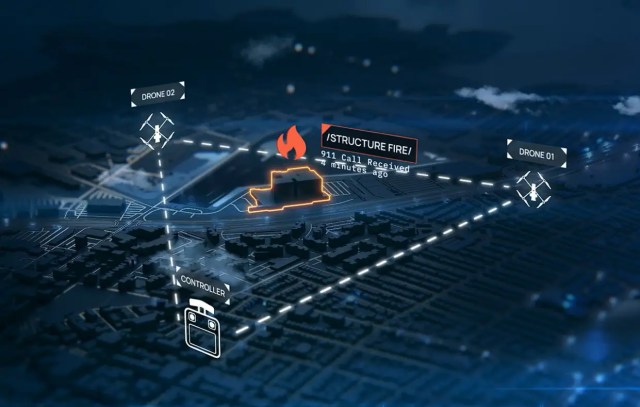
BRINC’s Responder is the first purpose-built hardware for Drone as First Responder (DFR) operations. It carries a 40x zoom visual camera array and a 640px thermal sensor. It also has emergency lights, a siren, and public safety markings. Paired with an autonomous charging dock called Station, it’s engineered to reach 911 calls in under 70 seconds. BRINC says it can resolve about 25% of calls without an officer being dispatched at all.
What makes the Responder different from a police department using an off-the-shelf drone?
Most DFR programs before this adapted consumer or enterprise drones for the job. BRINC built the Responder specifically for it, with FAA-compliant night lighting, an anti-collision beacon, an integrated siren, and public-safety markings. None of that comes standard on a general-purpose enterprise drone.
How fast can it actually respond?
BRINC says the system is engineered to reach 911 calls in under 70 seconds. Station, its autonomous charging and deployment hub, handles the launch. The drone can take off without an officer physically present to release it.
Can it actually replace sending an officer?
For some calls, yes, according to BRINC. The company says the Responder can resolve about 25% of calls for service without officers being dispatched. Those are typically low-priority calls, where aerial situational awareness is enough to determine there’s no need for an in-person response. For calls that do need an officer, the drone can arrive first. It gives responders a clearer picture of what they’re walking into.
What else can it do beyond surveillance?
BRINC positions the Responder as capable of delivering life-saving medical supplies in addition to providing camera coverage. That extends its role from pure observation into a limited first-response capability while human responders are still en route.
Who makes it, and where’s it actually deployed?
BRINC was founded in 2018 by Blake Resnick, then a teenager inspired by the 2017 Mandalay Bay shooting. Las Vegas Metro PD was its first customer. Beyond the Responder, the company also sells Lemur, a throwable tactical drone that can right itself if it lands upside down. Police departments now running Responder programs include St. Louis city and county, Reno, and Montgomery County, Texas. League City, Texas plans to launch its program by the end of 2026.